
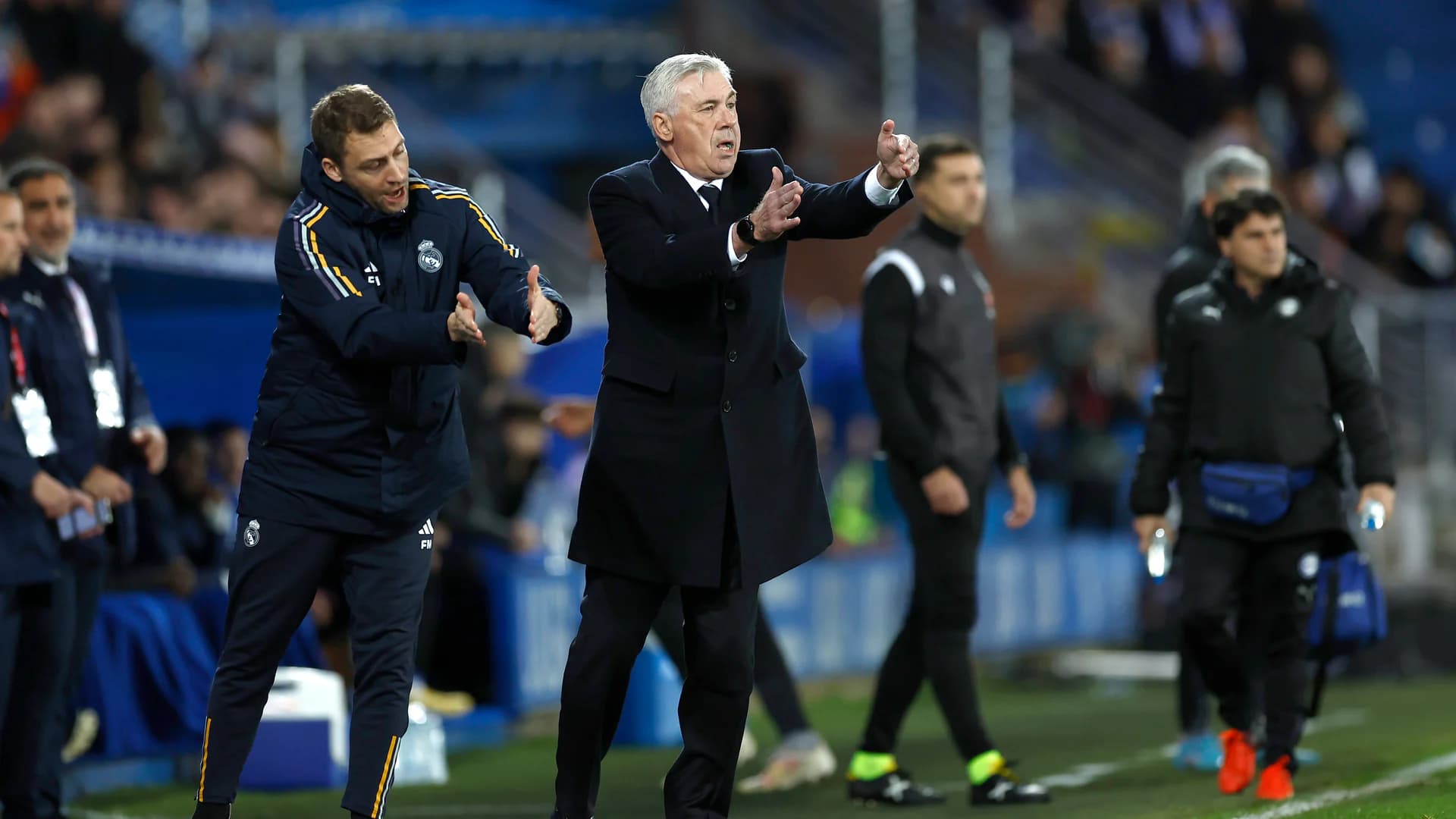
A winger moves inside. Who provides the width now? Who covers if the team loses the ball? Those are the questions to ask when discussing the freedom Ancelotti gives his players. In a UEFA interview in May 2024, he explained his approach: in attack, much depends on the players’ initiative; in defence, he demands organisation, concentration and commitment. [1]
One player’s movement changes everyone else’s job. If a midfielder runs into the box, a teammate needs to stay behind the ball. If a striker drops short to receive, someone else has to threaten the space behind the defence. The coach and players need a shared understanding of how those movements fit together.
Real Madrid in 2023 and 2024 offer several useful examples: Bellingham’s freedom in attack, Valverde’s work on the right and the changes made during the Champions League final. They show how Ancelotti matched roles to players and adapted when opponents exposed a weakness.
Start with the player, then choose the shape
In July 2023, Ancelotti looked back on his experience with Roberto Baggio. At Parma, he had been unwilling to change his preferred formation to accommodate Baggio, a decision he later acknowledged as a mistake. Working with Zidane at Juventus, he said, had helped him appreciate the value of building around a player’s strengths. He was recalling these episodes years later to explain how his thinking had evolved. [2]
For a coach, the practical question is simple: what does this player do best? Receive between the lines, beat a defender one-on-one, run in behind or arrive in the box at the right moment? The answer helps determine the player’s starting position in attack and the movements they can make from it.
A position on a team sheet tells only part of the story. Two attacking midfielders may do very different jobs: one continually offers a passing option between the lines, while the other bursts into that space from deeper. They occupy the same spot on the tactics board but need different conditions to be effective.
Bellingham is a good example. After the friendly against Milan on 24 July 2023, Ancelotti praised his movement off the ball and his runs into the box. Madrid were trying to progress through the centre more often and find space between the lines, the coach explained. He also acknowledged that there was still plenty to put right. [3]
Moving a player closer to goal is not enough to make better use of a strength. Who will get the ball to him? Who takes over the space he leaves? Who provides cover behind the attack? Without those answers, an attacking improvement can become a problem as soon as possession is lost.
How Madrid dealt with the wide areas
The midfield diamond made it harder for Madrid to defend out wide. Ancelotti said so directly on 26 September 2023: playing with two strikers made it easier to press the centre-backs, but left the team with more difficulty controlling the flanks in their own half. After the derby against Atlético, he wanted Madrid to stop allowing easy crosses and get more players back to defend the box. [4]
Teams that protect the centre well will recognise the problem. The opposition switches the ball wide and has time to cross. If the full-back steps out, somebody has to cover the space behind him. If he stays near the box, somebody else has to pressure the crosser. Unless those actions are coordinated, the opposition will still find the space.
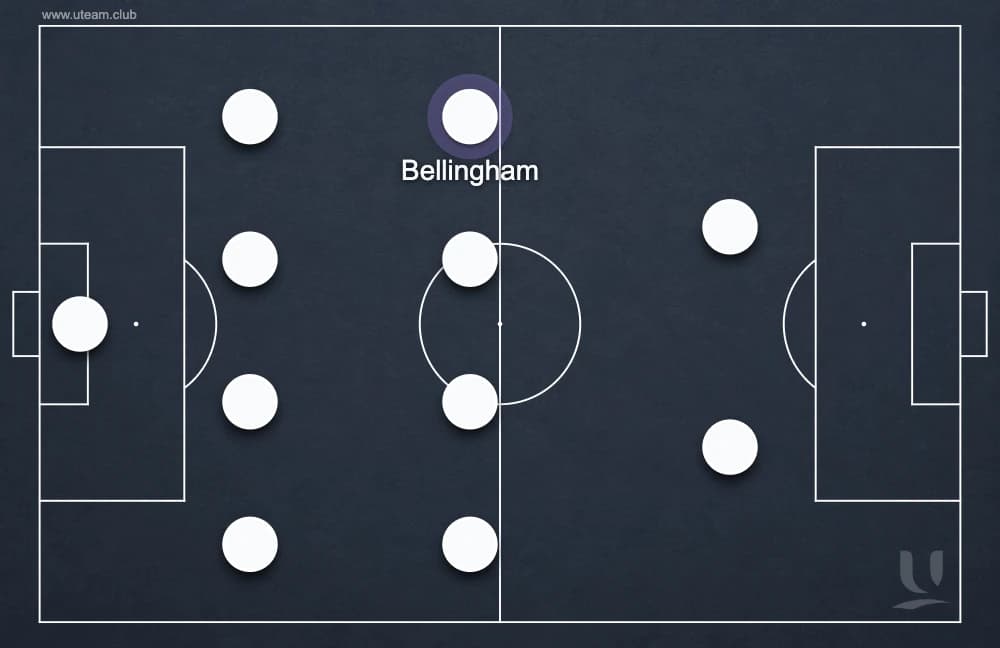
By 10 November 2023, Ancelotti was describing Madrid’s defensive shape as a 4-4-2: two banks of four, with Bellingham on the left of midfield. In possession, the shape still depended on the players’ movement and decisions. This was a particular adjustment during the season, rather than a formation the team had to use in every match. [5]
Out of possession · 4–4–2
In possession · freedom to move
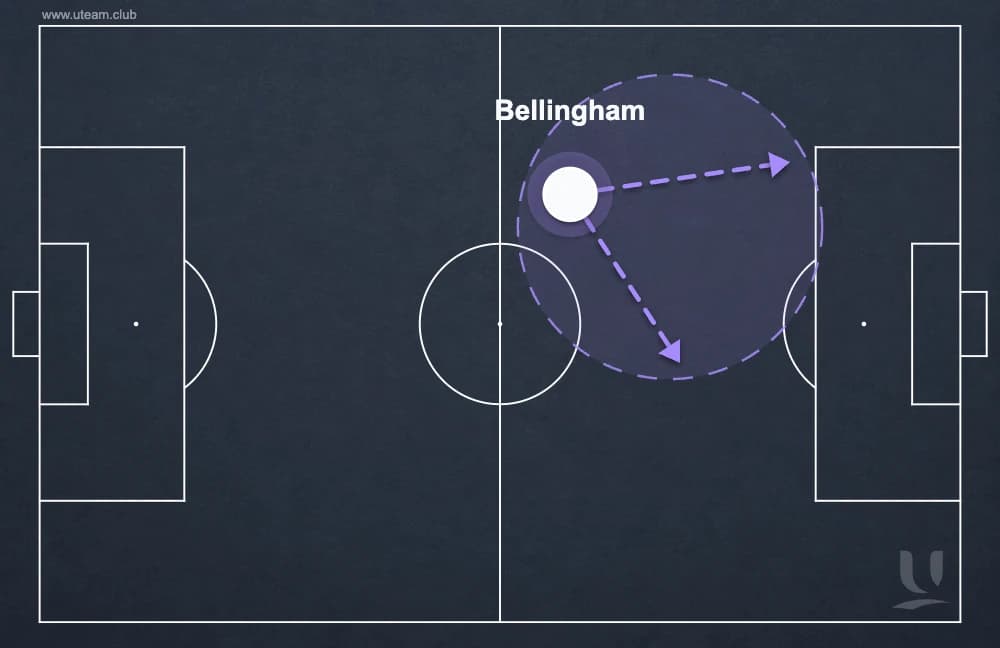
Bellingham’s role therefore cannot be reduced to one spot on the pitch. In attack, he could look for space and join the forwards. In a settled defensive shape, he had a place in the midfield line. What he should do immediately after a turnover, before the team had recovered its shape, was a separate question. This gives a much clearer picture of his role than a pre-match formation alone.
Why Valverde played on the right
In their analysis of Madrid’s home game against Liverpool in March 2023, UEFA’s technical observers described a 4-3-3 in possession and a 4-4-2 without the ball. Valverde helped defend the right flank, moved inside to support midfield and joined counter-attacks. Vinícius gave the team an outlet when playing out of defence. [6]
Valverde might appear in the front three on the team sheet, but his job went far beyond that. When Madrid had to defend, he needed to drop into midfield, then be ready to support the next attack. The role demanded both work rate and a good reading of the game: when to hold the flank, when to move alongside the central midfielders and when to go forward.
The same assignment may not work in another team. If the distances between players are too large, one player simply cannot cover both the flank and the centre. Before asking someone to do that much, use training to check where his teammates are positioned and when he is expected to move between roles.
Why Valverde moved inside in the final
In the Champions League final on 1 June 2024, Madrid themselves were having problems after losing the ball. Ancelotti explained afterwards that they were giving it away in the opposition half without being well positioned to defend. At half-time, they agreed to switch to a 4-3-3. He attributed the improvement after the break both to that change and to the players’ work. [7]
UEFA’s observers identified the specific changes: Valverde came in from the right to play closer to Kroos and Camavinga, while Rodrygo moved wider on the right. In their assessment, Madrid gained more control of the centre and were less exposed when they lost possession. In the first half, Dortmund had threatened in several ways, including passes behind the back line. [8]
This is a clear example of why a change to one player’s role must come with changes for his teammates. Valverde moved inside; Rodrygo took on the work out wide. Both players need to understand what has changed and who is now responsible for the space left behind.
That does not mean the positional change alone explains the win. Madrid’s first goal came from a corner: Kroos delivered and Carvajal headed in. The adjustment helped their play in possession and their cover behind the ball; the goal came from a set piece. A technical analysis needs to assess those things separately. [8]
When the cover does not arrive
The second leg of the semi-final against Bayern in May 2024 shows the other side of this approach. UEFA’s analysis noted that Musiala was finding space. Rodrygo was meant to help the central midfielders, but did not always manage to do so. Musiala was also involved at the start of the counter-attack that led to Bayern’s goal. That observation alone, however, does not make Rodrygo solely responsible: the whole group’s interaction needs to be examined. [9]
With your own team, start with a specific incident. Did the player fail to notice a teammate going forward? Was he late getting back? Or had he been given two jobs that could not be done at the same time? One teammate wants him nearby for a pass; another is already relying on him to provide cover. Telling him to “be more alert” will not resolve that on its own.
Agree which task takes priority and who will take over the other. Sometimes a small change to the starting position is enough. Sometimes you need to restrict a particular forward run or give the responsibility to another player. Review every similar incident, including those in which the opposition failed to exploit the space. The absence of a chance does not prove that the team was well positioned.
Turn individual roles into shared responsibilities
A simple table is a useful starting point: what the player does, how teammates respond and what the coach should watch. The table and practice below are UTEAM’s suggestions for coaching staff. They do not reproduce Ancelotti’s internal documents or training methods.
Choose one movement you would like to see more often in attack, such as a winger coming inside. Discuss its purpose, who will provide the width and how the team will defend if possession is lost. The examples below are starting points for a practice; your squad may need different solutions.
| Player’s movement | Teammates’ responsibilities | What to watch |
|---|---|---|
| The left winger moves inside | The full-back provides attacking width; the nearest midfielder covers his forward run | Is there a passing option out wide? Who could receive the opposition’s first pass after they regain possession? |
| A midfielder runs into the box | Another central midfielder stays behind the attack to offer a return pass and provide cover if the ball is lost | Is there an option to play back? Who will protect the centre if possession is lost? |
| The striker drops short to receive | A teammate threatens to run behind the defence | Is there a forward passing option, or is everyone coming towards the ball? |
Writing the roles down quickly exposes conflicting instructions. You might be asking the same midfielder to support an attack near the box and cover it from deep. He can combine those jobs only if he knows when he is allowed to go forward and who will stay behind in his place.
Next, agree on the cue for a change of position. It could be a pass out wide, a teammate turning with the ball or an opposing defender stepping out of the back line. Both players need to read that moment in the same way. “Get across in time” is too vague: it does not tell the player what to look for.
Ask the players to explain their jobs in their own words. One describes when and where he will move to receive; the other explains how he will respond. If their answers do not match, work through the situation again before the practice starts, rather than discovering the disagreement during play.
Take it onto the training pitch
To work on the team’s tactical organisation, play 11 against 11 on a full-size pitch, with ten outfield players and a goalkeeper on each side. This lets you work on the whole team’s relationships: maintaining the shape, keeping appropriate distances between the lines and providing cover when players join the attack. Set the length of each period to suit the players’ age, fitness and the aim of the session.
In the first period, give the team one tactical task, such as bringing a winger inside. Agree beforehand who will move into the wide area, who will support the attack and how the remaining players will position themselves to deal with a turnover. Let the opposition play freely, choosing how to defend and where to attack when they win the ball. This will show how well the team coordinates its adjustments around that movement.
Avoid loading the game with extra conditions. A touch limit, a minimum pass count and several bonus rules all at once make it difficult to understand why players are making particular decisions. Start with one task and watch how they solve it.
In the second period, keep the same teams and pitch size, but remove the specific condition and the coaching from the touchline. Do the players still choose when to move inside? Do teammates take up the right positions in time? If those relationships hold, test them further in matches. One good period in training does not guarantee the same response against a different opponent.
For the review, select a period in advance and collect every instance of the movement. Note where the player went, how teammates responded, which space was left and what the opposition did. Record the outcome of the attack separately. A good shot does not erase a problem with defensive cover; losing the ball after a well-coordinated move does not make everything that came before it wrong.
What to try with your team
In these examples, Ancelotti adapted the shape to his players’ qualities and the demands of the match. Bellingham sought space further forward and returned to the left of midfield when defending. Valverde helped on the right, then was needed centrally in the final. Each decision required teammates to take on some of the work in the areas those players had left.
Start with one player and one movement he already makes. Talk through the responsibilities with the players around him, test them in a training game and revisit the same questions in the match review. That will help you see what is working for the team and what needs adjusting.
We look further at defensive cover and the response to losing possession in our article on transitions and PSG. For tools to plan training sessions and prepare tactical diagrams, visit UTEAM Club. [10, 11]